
Passage from Homer’s Iliad discovered in the abdomen of a Roman-era Egyptian mummy

A passage from Homer’s Iliad has been discovered inside the abdomen of a Roman-era Egyptian mummy
A snippet of text from Homer’s famous epic recounting the siege of Troy was apparently placed inside this body as part of the mummification process
It’s not unheard of for someone to love a book so much that they ask to be buried with a copy of it. But a mummy entombed in an Egyptian necropolis takes that sentiment to the extreme.
Researchers discovered the mummy at a funerary complex located south of Cairo, in Al Bahnasa, the modern-day location of the ancient Greco-Roman city of Oxyrhynchus, during an excavation in late 2025. Upon examination, the team revealed a sheet of papyrus inside the mummy’s abdomen that contained text from the Iliad, the ancient Greek poet Homer’s epic account of the siege of Troy.
The passage is from Book II of the epic poem, in which Homer cataloged the Greek ships that came to do battle with Troy after Helen, the queen of Sparta and a daughter of Zeus, was taken there by Paris, the son of the king of Troy.
On supporting science journalism
If you’re enjoying this article, consider supporting our award-winning journalism by subscribing. By purchasing a subscription you are helping to ensure the future of impactful stories about the discoveries and ideas shaping our world today.
The researchers previously found scrolls in some of the other mummies interred inside three limestone chambers at Al Bahnasa, all of which date to the era of Roman rule over Egypt, which began in 30 B.C.E. and ended around C.E. 640. The newly examined mummy’s tomb dates to about 1,600 years ago, according to the researchers. None of the scrolls discovered inside other mummies at the site, however, contained any references to the Iliad, which would have already been considered a literary classic at that time.
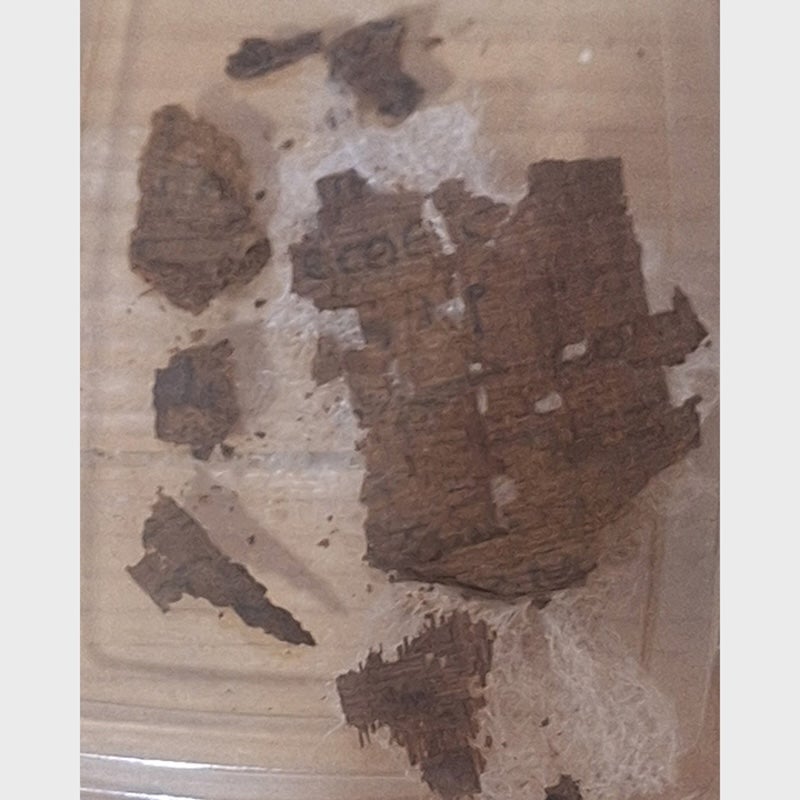
A papyrus containing a snippet of the Iliad that was found in an Egyptian mummy.
“This is not the first time we have found Greek papyri, bundled, sealed, and incorporated into the mummification process, but until now, their content was mainly magical,” said Ignasi-Xavier Adiego, a professor of classical, Romance and Semitic languages at the University of Barcelona in a statement. Others contained ritualistic content.
“It is worth noting that, since the late 19th century, a huge number of papyri have been discovered at Oxyrhynchus, including Greek literary texts of great importance, but the real novelty is finding a literary papyrus in a funerary context,” he added.
The excavation was part of the University of Barcelona’s Oxyrhynchus Archaeological Mission, which launched in 1992.
It’s Time to Stand Up for Science
If you enjoyed this article, I’d like to ask for your support. Scientific American has served as an advocate for science and industry for 180 years, and right now may be the most critical moment in that two-century history.
I’ve been a Scientific American subscriber since I was 12 years old, and it helped shape the way I look at the world. SciAm always educates and delights me, and inspires a sense of awe for our vast, beautiful universe. I hope it does that for you, too.
If you subscribe to Scientific American, you help ensure that our coverage is centered on meaningful research and discovery; that we have the resources to report on the decisions that threaten labs across the U.S.; and that we support both budding and working scientists at a time when the value of science itself too often goes unrecognized.
In return, you get essential news, captivating podcasts, brilliant infographics, can’t-miss newsletters, must-watch videos, challenging games, and the science world’s best writing and reporting. You can even gift someone a subscription.
There has never been a more important time for us to stand up and show why science matters. I hope you’ll support us in that mission.