
Poem: ‘My Father Flies into a Hurricane’
Edited by Dava Sobel
They fly from the Caribbean sun into
the storm’s spiraling arms; their turbo prop
jolts and shudders. Across his window, streaks
of rain begin. They’re flying into darkness,
the plane all fumes and metal shell, he thinks,
as they head for the eye. All along, they’re dropping
instruments to map vertically
pressure, temperature, wind direction
and speed, data in three dimensions plus time.
He’s read about these trips: to enter the gyre’s
racket of wind and rain, the crew harness
themselves in place. Between them and death,
two pilots’ strength—no parachutes; ejecting
futile in winds like these. He’s wanted to feel
how frail humans are against the force
of atmosphere, to feel its energy,
a bow to what he’s studied all these years:
his, the fifth American doctorate
in meteorology. The War made the field:
so many forecasts crucial to success in invasions
or bombing raids. He judged jet stream effects,
then returned, afterwards, to equations—physics
of air and water, the way they interact—
but he’s wanted to go inside the living fact.
The Center called him once the storm had blown
past St. Lucia, Haiti, Jamaica, its eye
sliding between Cuba and the Yucatán.
Towards the eye wall, the storm grows wild—
winds strongest, noise loudest, no turning
around. He wonders why he’s left the ground
as the plane pulls, jerks, falls and climbs
in the hurricane’s judder and thrash. Updraft
(pressed hard against his seat) and down
(dropping many feet abruptly; his stomach
turning). Stowed gear rattles at the latches.
Updraft (harder, longer) and down (harness
cuts into his shoulders as he’s thrown about).
He wants out; he wishes he hadn’t asked.
And just as he thinks he can’t stand more,
they’re through the wall, which rises behind,
a cliff of cloud, steeper than a stone canyon
and deeper. They turn in the light, sun overhead
in the calm, open space inside the eye,
then spiral down to look for a sailboat reported
lost. No way to see a thing so small
in such high waves. He’s surprised how tiny the plane’s
whirring sounds after the din in transit.
He thinks of how, on the ground, birds sing
in this brief reprieve. But here he can see the edge:
the plane must turn into the hurricane
again, cross the wall, cross into
disturbance, only now they know:
this one’s big. They’ve got air pressure
readings lower than any they’ve seen.
A category five, they reckon, and strengthening:
winds hitting 190 miles per hour.
They cut through the wall, adrenaline high.
No escape. Only the wind’s unholy
engine, its sharp shifts in all directions.
So long as the pilots’ combined strength can keep
the plane level and on course (they fight for control),
so long as the plane holds together (it cracks
and creaks), so long, he thinks, as his nerve holds …
But unlike the first half of this flight, when chaos
deepened the further they went, now however
wild the wind, they know it lessens; the battering
eases. They cross into sun: below them, glints
on the ocean’s surface. But since they’ve mapped the winds,
crossed the eye wall, over and back, they know
more. Which saps pleasure in rediscovered
calm. He finds his body’s damp—shirt soaked
and stinking; he finds standing again an effort.
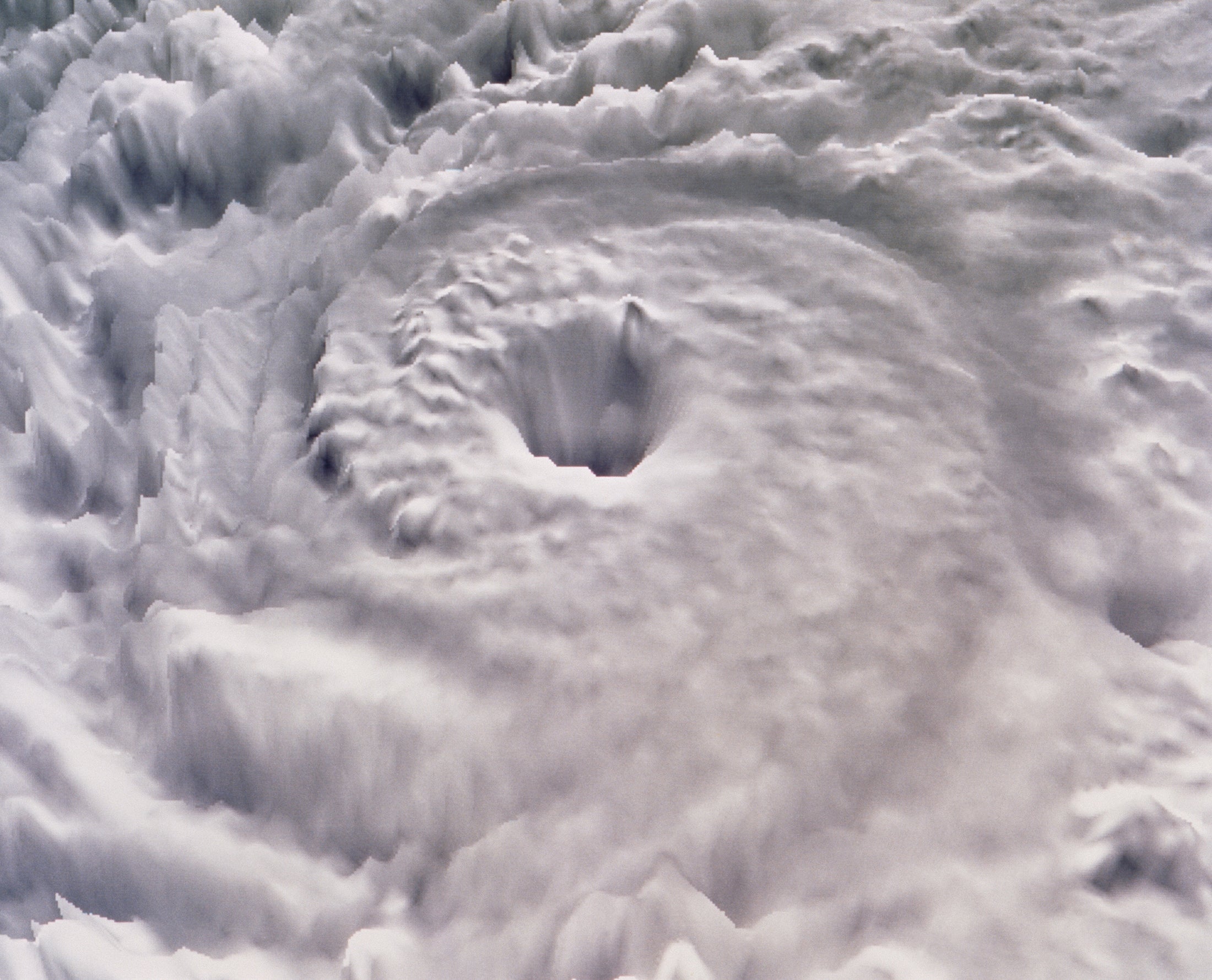
On his wall he’s hung the storm’s huge spiral
and the date: August 7, 1980.
From space, the satellite registered its shape—
almost fetal, outsized head around
an eye, wisps of arms as if a sonogram
had gathered this “Allen” before landfall,
his massive fetch, the sum of possible destructions;
the given: thrum of wind and roiling waters
and the taken, 269 souls.
Fifth then among Atlantic hurricanes
on record, that’s the flight he asked to join.
And why, I wonder, do I imagine him now?
Perhaps I fancy a kind of bliss at the core
of disorder—a blue-sky temporary respite:
assurance that all this trouble will blow over.
How then can we account for ourselves, my father
and I, then and now, as we cut across asphalt
to head home through tangles of evening traffic?
As if nothing has happened.