
Numerical Methods for Scientific Computing: The Definitive Manual for Math Geeks

Price:
(as of – Details)
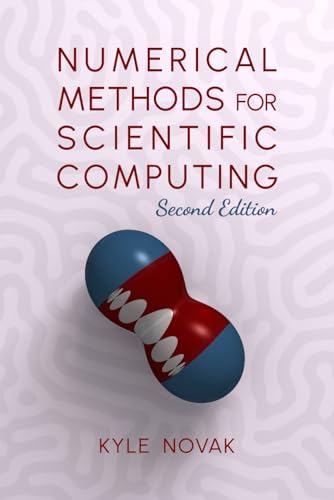
Numerical methods are ubiquitous in scientific research, often working quietly behind the scenes in algorithmic black boxes. Practitioners who use such black boxes don’t always know what’s happening inside them, sometimes leading to inaccurate or inefficient solutions and occasionally flat-out wrong ones. This book breaks open the algorithms to explain how they work and why they can fail. It helps develop both the intuitive understanding of the underlying mathematical theory and practical skills for research.
This book teaches not only how to be a critical user of scientific computing algorithms but also a knowledgeable creator of them. Ideal as an introductory text for senior undergraduate and first-year graduate students, as a self-study for anyone with a working knowledge of multivariate calculus and linear algebra, and as a modern reference on numerical methods for researchers.
This revised edition, extensively rewritten and expanded, provides a comprehensive guide to using numerical methods in linear algebra, analysis, and differential equations. Examples and exercises are worked out in detail. This book includes extensive commentary and code for three essential scientific computing languages: Julia, Python, and Matlab/Octave
Kyle Novak is an applied mathematician, data scientist, and decision analyst with twenty-five years of experience on topics ranging from autonomous systems and cryptanalysis to complex networks and federal policy. He is the author of Special Functions of Mathematical Physics: A Tourist’s Guidebook and is featured in the American Mathematical Society’s 101 Careers in Mathematics.
From the Publisher
.
A comprehensive textbook and reference manual of the essential tools of modern scientific computing


Linear algebra
Topics include LU and QR decomposition, linear programming, nonsquare systems, rank reduction, regularization, eigenvalue computation, singular value decomposition, sparse systems, iterative methods, conjugate gradient and Krylov methods, the fast Fourier transform, and more.
Numerical analysis
Topics include well-posedness, zeros and extrema of nonlinear equations, dynamical systems, fixed-point iteration, splines and Bézier curves, function approximation, neural networks, Chebyshev polynomials, wavelets, automatic differentiation, Gaussian quadrature, Monte Carlo methods, and more.
Differential equations
Topics include ODEs and PDEs, multistep methods and Runge–Kutta methods, stiff equations, IMEX methods, convergence and stability analysis, parabolic equations, nonlinear hyperbolic systems and shocks, the finite element method, the Fourier spectral method, and more.
Julia, Python, and Matlab
Topics are developed using three major scientific programming languages: Julia, Python, and Matlab. Each language has an accompanying online Jupyter notebook. QR codes in the book let you run Python and Matlab language scripts from your smartphone.
Designed for researchers, engineers, data scientists, and educators


Researchers
This book explains the mathematics underpinning numerical methods necessary to build trustworthy models and simulations.
Engineers
This book provides practical advice on using scientific computing packages to solve real-world problems and design efficient specialized routines.
Data scientists
This book explains the mathematics of machine learning, including neural networks, dimensionality reduction, logistic regression, and nonlinear least squares.
Educators and students
This book is ideal for advanced undergraduate and first-year graduate students or self-study for anyone with a working knowledge of calculus and linear algebra. Solutions to exercises are worked out in detail.
Examples from the book


Original image
Images are fantastic for numerical tinkering. They can be used as surrogates for complex data sets and initial conditions for PDEs. The book examines several techniques to represent data in lower dimensions.
SVD rank reduction
Singular value decomposition is a standard tool in statistical analysis and machine learning. It reduces the original image to a series of principal components. The picture above is the first principle component.
Discrete cosine transform
Discrete cosine transforms use FFTs to represent the image as a series of Fourier components. We can discard small magnitude components and save the resulting sparse matrix in compressed format.
Discrete wavelet transform
Discrete wavelet transforms provide another way to compress information. Wavelets break an image into a series of components called frames that encode the image across multiple resolutions.
Examples from the book


From intuition…
Complex mathematics and physical phenomena often have simple analogies. For example, we can use a colony of ants to understand nonlinear diffusion.
…to theory…
Starting from first principles, we develop a partial differential equation. Then, we discretize the system so that we can solve it numerically. We need to be careful about numerical stability.
…to implementation…
Next, we chose a suitable ODE solver. Scientific programming languages have plenty of them, each suited for particular classes of problems. This book solves every problem in Julia, Python, and Matlab.
…to understanding.
We’re not done, yet. We can examine the solution in several different ways. This book complements the printed page with online Jupyter notebooks and animations you can view with your smartphone.
ASIN : B09VFRYB4W
Publisher : Equal Share Press (March 13, 2022)
Language : English
Paperback : 730 pages
ISBN-13 : 979-8985421804
Item Weight : 2.63 pounds
Dimensions : 6 x 1.65 x 9 inches